
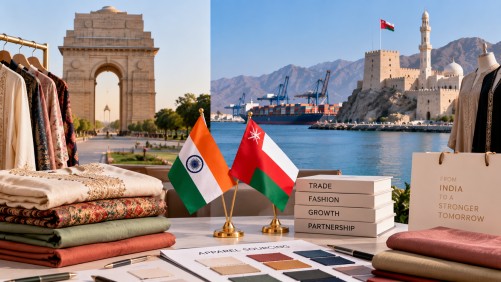
The India-Oman Comprehensive Economic Partnership Agreement (CEPA) is opening new avenues for apparel companies in Oman and the Gulf region to acquire textiles and garments from Indian manufacturers. This agreement spans a variety of sectors, including manufacturing, energy, and technology, and is particularly beneficial for the fashion industry by improving market access. This enhancement is expected to forge stronger connections between Indian textile producers and fashion brands, retailers, wholesalers, and private-label businesses operating across Oman and other GCC markets.
A central element of this agreement is Oman’s pledge to grant preferential market access to a significant portion of Indian exports. Official statements indicate that over 98% of Oman’s tariff lines are covered by duty-free access, representing nearly all Indian exports by value. For textile and apparel companies, the reduction or elimination of customs duties can influence the landed cost of imported products, offering businesses more flexibility in pricing, margins, and sourcing strategies. However, the real advantage for each apparel product hinges on the specific tariff classification, rules of origin, and other stipulations set by the agreement.
India’s well-established textile industry presents another potential benefit for Gulf fashion entities. The country’s manufacturing ecosystem encompasses multiple production stages, from fiber and spinning to weaving, knitting, dyeing, finishing, and garment manufacturing. This comprehensive range of capabilities allows international clients to source fabrics, trims, and finished garments through interconnected supplier networks. Indian manufacturers cater to a wide array of segments, from everyday apparel to premium, technical, and performance clothing, granting brands in Oman, the UAE, Saudi Arabia, Qatar, Kuwait, and Bahrain additional sourcing options as they aim to diversify their supply chains.
Beyond trade between India and Oman, the CEPA could transform Oman into a regional distribution hub. Oman’s strategic location and its port infrastructure, including Duqm, Salalah, and Sohar, offer vital connections to international maritime trade routes. Apparel companies might find a promising model in combining Indian manufacturing with distribution operations based in Oman, which could streamline inventory management and customer supply in regional markets. The feasibility of this model will depend on transportation costs, customs procedures, warehousing, demand trends, and the final product destinations.
The convergence of preferential trade access, a robust textile manufacturing base, and growing capabilities in sustainable and technical apparel is positioning India as an increasingly attractive sourcing destination for Gulf fashion supply chains. Manufacturers offer a spectrum of services, from product development and fabric sourcing to pattern making, sampling, production, quality control, and export coordination. These services are particularly appealing to brands seeking private-label or customized manufacturing over standardized wholesale products. Companies like NoName, an Indian apparel manufacturing and sourcing firm, are looking to connect Indian manufacturing strengths with the rising sourcing needs in Oman and other GCC markets. The India-Oman CEPA sets the stage for enhanced commercial ties, offering Gulf fashion companies a new avenue for sourcing and supply-chain diversification, contingent on factors like product-specific tariff rules, origin requirements, logistics costs, and the establishment of reliable long-term partnerships.
Legal Disclaimer:
The information contained in this article has been provided by independent third-party contributors, clients, or content partners. We do not independently verify the accuracy, completeness, legality, ownership, licensing, or reliability of submitted content, including text, images, videos, trademarks, or other media materials. The submitting party is solely responsible for ensuring that all content, including images and media assets, complies with applicable copyright, trademark, licensing, and intellectual property laws. We disclaim liability for any unauthorized use of copyrighted or proprietary materials by third parties. If you believe that any content published on this platform infringes your intellectual property rights, kindly contact the author above for prompt review and resolution.